The Beam Engine
The Wanlockhead Beam Engine
Rain water collecting in the mines was an eternal problem for the miners. Some of the mine workings extend below sea level. The Beam Engine is a rare survivor of an ingenious, water powered pump used to remove water from Straitsteps Mine.

It is said that its origins were based on an attempt to create a ‘perpetual motion’ machine. It is the only remaining example in its working site in the UK today. Beam engines and water-bucket pumps were introduced in the Wanlockhead mines in 1745. This Beam Engine worked until 1910.
No certain history of the Wanlockhead Beam Engine has been found to date, but descriptions of similar engines have survived from 1745. One is recorded to have been used on a coal mine at Canonbie, Dumfriesshire in the 1790’s.
The Beam Engine has Scheduled Monument status and is maintained by Historic Environment Scotland. A working model of the Beam Engine is one of several models in the museum.
Where the landscape made it possible, a drainage level was used to drain underground workings by the use of gravity alone. These were constructed on similar lines to those designed by the famous Dutchman, Cornelius Vermuyden in the 1630’s. As the mines became deeper, engineers designed more powerful pumps to dewater the mines.
Hand pulled, rag and chain pumps were employed by Sir James Stampfield at the Straitsteps Mine between 1675 and 1684. In the late 17th century stream water was used to work the drainage pumps. In 1710 two waterwheel-powered pumping engines, known as ‘bab-gins’ were used at Straitsteps Mine. As late as 1816 water was being raised by teams of 24 men, using hand pumps and working around-the-clock at the Lochnell mine.
Eventually, at the end of the 19th century, steam driven pumps were used to dewater the mines. It was both difficult and expensive to transport coal to the mining village.
The waterbucket pump engine was very cost effective to operate as it only required water power. As long as there was water to fill the bucket, the pump would work continuously. The simple ‘nodding’ action earned them the name of ‘bobbin’ Johns’. Beam Engines were mainly constructed from wood and they quickly disappeared when they fell into disuse following the advent of steam pumping engines. Only a few are recorded in the mid 19th century.
The beam is made up of two thick pieces, or baulks, of pitch pine and is 8.03m (26′ 4″) long, 61cm (2′) deep and 28cm (11″) wide. Wrought iron straps bind the two baulks together and there are carved reinforcing pads at the centre and ends. The Beam is mounted on a pillar of dressed freestone 4.27m (14′) in height and measuring 2.1m (7′) by 91cm (3′) at the base. It has a carved cornice and is similar in style to many 19th century railway bridge piers.
Many of the iron parts are held together with wedges and cotters, which are traditional fastenings used by early millwrights. However, on closer inspection it appears that a number of small locking screws have been used and bearings have been turned on a lathe. This suggests the use of 19th century machine tools. A mine report of 1883 mentions an ‘auxiliary pump’ being used at the south end of the vein and this may refer to the present Engine. It is also possible that the Engine had previously been erected elsewhere.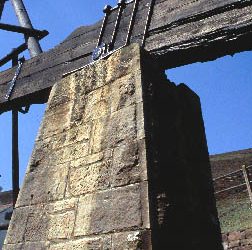

The problems of removing water from the lead mines brought some of the most famous engineers of the time to the area including Watt, Boulton, and Symington.
The second Boulton & Watt steam pumping engine to be built in Scotland was erected at the Straitsteps Mine in 1779. Later this was replaced by a larger Watt engine. In 1900, steam was used to drive the pumps in Wanlockhead. This was provided by three Babcock & Wilcox steam boilers.
William Symington (1763-1831), was born in Leadhills, but lived and worked for most of his life in Wanlockhead. His brother, George, was the mines’ engineer at Leadhills. William built the ‘improved atmospheric steam engine’ which replaced the Boulton and Watt pump engine in 1789. He is the inventor of the first steam powered ship, the Charlotte Dundas. The engine for this ship was built in the Old Manse in Wanlockhead.
Exactly how his ideas were taken up by Henry Bell and Robert Fulton, who are credited with the invention of steam navigation, is shrouded in mystery. William returned to Sanquhar in Dumfriesshire where he continued to make pumping engines, but he died in London an impoverished and embittered genius.
Find out more about the Beam Engine
You can now book your Museum of Lead Mining tour online!